Home › Comparisons › Ghost vs Substack
Ghost vs Substack: it comes down to one number
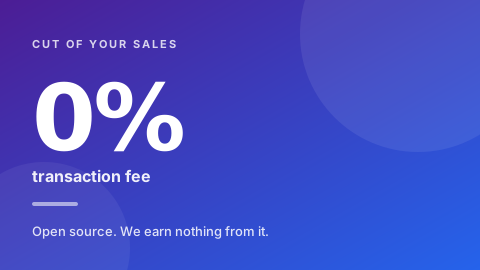
Substack takes 10% of what you earn. Ghost takes $29 a month and 0% of what you earn. Everything else is detail around that trade.
 Ghost
vs
Ghost
vs
 Substack
The short answer
Earning under ~$290/month from subscriptions? Substack. It costs you nothing, requires no setup, and its discovery network actively sends you readers — which is worth more than margin when you have no revenue to take a margin on.
Earning over ~$290/month? Ghost. Past that point the 10% cut exceeds Ghost's flat $29, and the gap widens every month you grow. At $2,000/month in subscriptions you keep $2,052 more per year on Ghost.
Most writers should start on Substack and move. That isn't a cop-out — it's what the arithmetic says, and Substack lets you export your list, so the move is real rather than theoretical.
Side by side
| Ghost | Substack | |
|---|---|---|
| Fixed cost | $15/mo Starter · $29/mo Publisher (needed for paid subs) | $0 |
| Cut of your revenue | 0% | 10%, plus card fees on top |
| Cost at $1,000/mo revenue | $29 | $100 |
| Cost at $2,000/mo revenue | $29 | $200 |
| Discovery network | Minimal | Strong — a real growth channel |
| Setup effort | Moderate | Almost none |
| Design control | Full — custom themes on Publisher | Minimal |
| Own the software | Yes — open source, self-hostable | No |
| Export subscribers | Yes | Yes |
| Email sends | Unlimited | Unlimited |
| Automation | Thin — expects Zapier/n8n | None |
| Run by | Non-profit | Venture-backed company |
Ghost prices at the 1,000-member tier, billed yearly. Both verified against the vendors' own pages on 16 September 2026.
The crossover, worked through
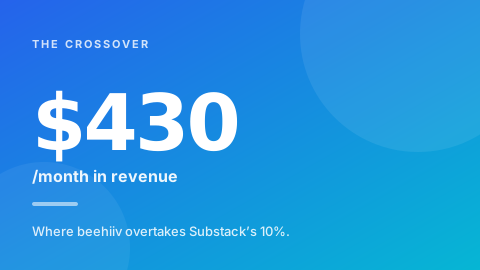
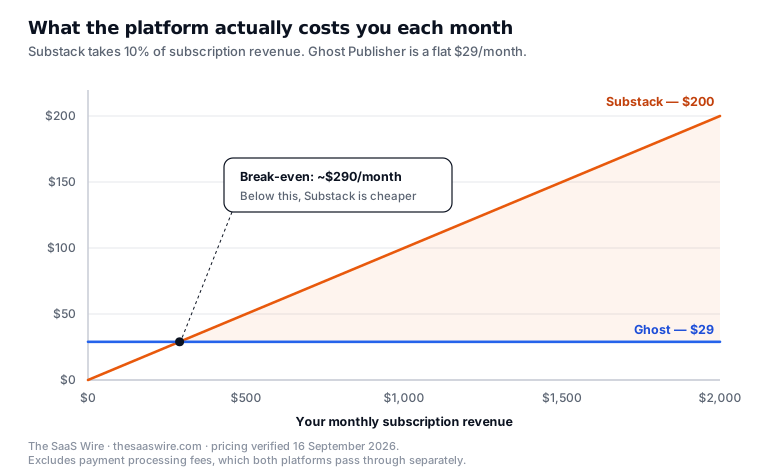
Substack's cost is 10% of revenue. Ghost Publisher's is $29 flat. Setting them equal: 0.10 × revenue = $29, so revenue = $290/month.
- $0/month revenue — Substack $0, Ghost $29. Substack wins by $29.
- $290/month — both $29. Dead heat.
- $1,000/month — Substack $100, Ghost $29. Ghost wins by $71/month.
- $2,000/month — Substack $200, Ghost $29. Ghost wins by $171/month, or $2,052/year.
One caveat that favours Ghost slightly more than the chart shows: Substack's 10% is taken before card processing, which is charged separately. Ghost's $29 is the whole platform cost; you pay Stripe directly either way.
One caveat that favours Substack: if you outgrow 1,000 members on Ghost, Publisher's next step is the $199 Business plan, with nothing in between. At 1,001 members your Ghost cost jumps nearly 7x. It's still cheaper than Substack at high revenue, but the step is abrupt and worth planning for.
Beyond the money
Where Substack genuinely wins
- Discovery. Substack's network recommends publications to readers, and for a new writer that's often the difference between 50 subscribers and 5,000. Ghost has nothing equivalent — you bring your own audience.
- Zero friction. No plan to choose, no domain to configure, no theme to pick. You write and press send.
- No fixed cost. $0 while you build. That matters more than most people admit in year one.
Where Ghost genuinely wins
- The economics at scale. Covered above, and it compounds.
- Ownership. Open source means you can self-host; nobody can deplatform you or change the terms.
- It's a real website. Custom themes, proper SEO tooling, your own design. Every Substack looks like Substack.
- Governance. Ghost is a non-profit with no investors expecting returns — historically the reason platforms get more extractive over time.
There's also a reputational dimension worth naming plainly: Substack has been through public controversies over what it does and doesn't host, and your publication sits under that brand. Whether that matters is your call, but it's a real factor for some writers and we'd rather say so than pretend the choice is purely financial.
Questions we get asked
Should I just start on Ghost to avoid migrating later?
Usually no. Migration is a weekend of work; starting on the wrong platform for two years costs more. The exception is if you already have an audience elsewhere — a large mailing list, a following you can redirect. If launch day comes with 2,000 readers, Substack's discovery advantage doesn't apply to you and you may as well start on Ghost.
How hard is the migration?
The list moves cleanly — Substack exports subscribers including who's paying, and Ghost imports it. Two things hurt: paying subscribers may need to re-authorise payment, and your Substack URLs and the search rankings attached to them stay behind. Do it in a quiet week and tell readers in advance.
What about self-hosting Ghost to avoid the $29?
Viable, and genuinely cheap — a small server plus an email-sending service. But you own updates, backups, security and, hardest of all, email deliverability. If you'd rather write than administer a server, Ghost(Pro)'s $29 is buying you something real.
Self-hosting makes the most sense in the awkward 1,000–3,000 member range, where Ghost(Pro) would push you onto the $199 plan.
Do you make money from either of these?
No. Neither runs an affiliate program, so this page earns us nothing. We wrote it because it's the question readers in this category most often need answered — and we'd point out that it's also the most reliable page on our site, precisely because we have no stake in your answer.
The verdict
Start on Substack. Move to Ghost when your subscription revenue passes about $290 a month.
Substack's real product isn't the software, it's the readers — and while you have none, that's worth more than the 10% it costs. Once you're earning, that same 10% becomes the most expensive line item in your business, and Ghost's flat fee and 0% cut turn into a permanent raise.
The one thing to do today, whichever you pick: confirm you can export your subscriber list. Both let you. That single fact is what makes this a reversible decision rather than a permanent one — and it's why you shouldn't agonise over it.
Pricing read from each vendor's own page on 16 September 2026. Substack's 10% and the "keep 90% less credit card fees" wording come from its own creator page. Under our methodology this comparison is at the "researched, not tested" level. Found something out of date? Tell us.
Read more: Ghost review · Best email marketing software for creators (2026)