Ghost review: 0% fees, and a price cliff to plan around
The platform to choose if you've thought about what happens when a company changes its mind — with two cost traps worth knowing before you commit.
The short verdict
Use Ghost if you charge readers, or plan to. It takes 0% of subscription revenue where Substack takes 10% forever. It's also open source, so you can self-host and nobody can deplatform you, raise your rent, or decide your topic is off-brand.
Pick something else if you need automation, or if you want a free plan. Ghost(Pro) has no free tier, its native automation is thin enough that it expects you to wire up Zapier or n8n, and the leap from $29 to $199 is the steepest in this category.
Two cost traps: the advertised $15 Starter cannot take payments — paid subscriptions start at $29. And there is nothing between Publisher ($29) and Business ($199), so outgrowing 1,000 members means a near-7x increase.
What Ghost is
Ghost is an open-source publishing platform — a website, a newsletter and a membership system in one — run by a non-profit organisation. That last detail is not trivia. It means there is no investor expecting a return, which is the usual reason platforms get more expensive and more extractive over time.
You can run Ghost two ways. Self-hosted, the software is free and you pay only for a server and an email-sending service; you also own every part of it and nobody can remove you. Or on Ghost(Pro), the official managed hosting from $15/month, where the Ghost team handles updates, backups, CDN and deliverability — and the revenue funds development of the open-source project.
What it costs
Read from Ghost's pricing page on 16 September 2026, at the 1,000-member tier, billed yearly.
| Plan | Yearly | Members | Staff | Paid subscriptions? |
|---|---|---|---|---|
| Starter | $15/mo | 1,000 | 1 | No |
| Publisher | $29/mo | 1,000 | 3 | Yes — 0% fees |
| Business | $199/mo | 10,000 | 15 | Yes — 0% fees |
| Custom | On request | Unlimited | Unlimited | Yes — 0% fees |
| Self-hostedopen source | $0 + infra | Unlimited | Unlimited | Yes — 0% fees |
Email sends are unlimited on every plan, and a free custom domain is included even on Starter. Self-hosting is genuinely free software, but you pay for a server and an email provider, and you own the maintenance.
The 0% maths, worked through
Ghost's headline advantage is that it takes nothing from your subscription revenue. Substack takes 10% — and, per Substack's own page, that's before card processing, which is charged on top.
Since Ghost charges a fixed fee and Substack charges a percentage, there's a single crossover point:
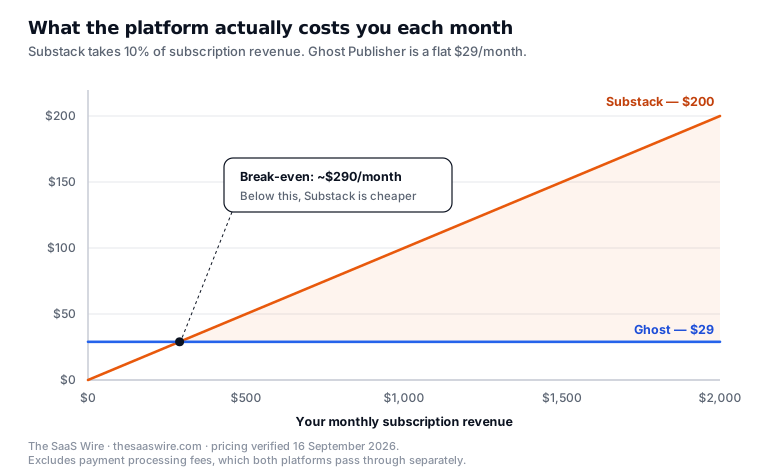
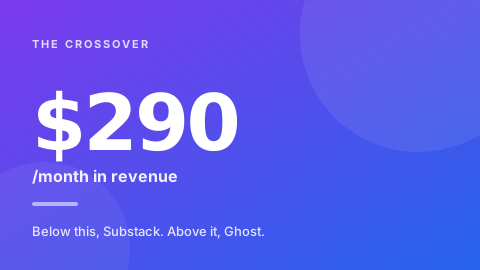
- At $290/month revenue the two cost the same: $29.
- At $1,000/month, Substack takes $100 and Ghost costs $29. You keep $71 more every month.
- At $2,000/month, Substack takes $200 and Ghost still costs $29 — a difference of $2,052 a year.
The honest counterpoint: below the crossover, Substack is genuinely cheaper, and Substack's discovery network sends you readers that Ghost simply doesn't have. Ghost costs you $29 a month before you've earned a cent. Growth is worth more than margin when you have no revenue to take a margin on.
The price cliff
The other thing to plan for: Publisher covers 1,000 members at $29. The next plan up is $199 for 10,000. There is nothing in between.
So the member who takes you from 1,000 to 1,001 costs you an extra $170 a month — a 6.9x increase — and then your price doesn't move again until 10,000. If you're going to land in the awkward 1,000–3,000 range, that's the moment self-hosting starts making real financial sense, and it's the strongest practical argument for Ghost being open source.
Pros and cons

Ghost
Best if you want to own the platform- 0% transaction fees on paid subscriptions
- Open source — self-host free, no lock-in, no deplatforming
- Run by a non-profit: no investors pushing prices up
- Unlimited email sends on every plan
- Free custom domain even on Starter
- Excellent editor and genuinely good built-in SEO tooling
- 3 premium tiers and 15 special offers on Publisher
- $15 Starter can't take payments — paid subs need $29 Publisher
- $29 → $199 cliff with nothing in between
- No free plan on Ghost(Pro)
- Self-hosting needs real technical skill — server, updates, deliverability
- Weak native automation; expects Zapier or n8n
- No discovery network — you bring your own audience
- Starter limits you to 1 user and no custom themes
Who should and shouldn't use it
Strong choice for
- Anyone charging for a newsletter. The 0% cut is the single biggest financial difference in this category once you're earning.
- Writers who want to own their platform. Open source means the exit is always available and always yours.
- People publishing a real website, not just emails. Ghost's site and SEO tooling are the best here.
- Anyone with a topic a platform might get nervous about. Self-hosted Ghost cannot be deplatformed.
Look elsewhere if
- You haven't started earning. $29/month before your first paid subscriber is real money. Start on Substack and move at the crossover.
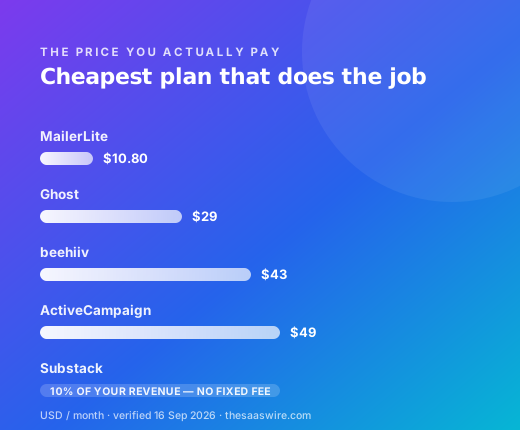
- You need automation. MailerLite gives you 50 automations for $10.80.
- You want help finding readers. Ghost has no discovery network; beehiiv's recommendation network and Substack's do.
Questions we get asked
Is Ghost really free?
The software is, genuinely — open source, self-hostable, no catch. But "free" means you run the server, apply updates, manage backups and own email deliverability, which is the hard part. Ghost(Pro) is the managed version from $15/month and there's no free tier of it.
Why does the $15 plan exist if it can't take payments?
It's aimed at people running a free newsletter and a website who don't intend to charge. That's a real use case — but if there's any chance you'll sell subscriptions, budget $29 from the start rather than being surprised later.
Can I move from Substack to Ghost?
Yes. Substack exports subscribers, including which ones are paying, and Ghost has a documented migration path. What doesn't transfer automatically is your Stripe subscription relationships — paying subscribers may need to re-authorise — and your Substack URLs and their search rankings stay behind. Plan the move for a quiet week.
You earn nothing from Ghost. Why review it at all?
Because it's the correct answer for readers who charge for subscriptions, and a comparison that omits the correct answer isn't a comparison. It's also the most direct evidence we can offer that our rankings aren't for sale — you can check it against the roundup, where Ghost is 3rd and Substack 5th, neither paying us anything.
The verdict
Ghost is the platform for people who intend to be doing this in five years. The 0% cut compounds, the open-source licence means the exit is always open, and the non-profit structure removes the usual reason platforms get worse over time.
But it's a poor first platform. $29 a month before your first paying subscriber, no discovery network, and a price cliff waiting at 1,000 members. The sequence that actually makes sense for most writers: start free somewhere with an audience network, and move to Ghost the month your subscription revenue passes about $290. At that point it stops being an expense and starts being the cheaper option — permanently.
Pricing read directly from Ghost's pricing page on 16 September 2026, in USD at the 1,000-member tier with yearly billing. Under our methodology this is at the "researched, not tested" level. Found something out of date? Tell us.
← Back to: Best email marketing software for creators (2026)