Home › Roundups › Email marketing for creators
Best email marketing software for creators (2026)
Five platforms, compared on what actually decides it: what the free plan really allows, where the price jumps, and how much it costs to leave.
The short answer
If you write a newsletter and want room to grow without paying yet, beehiiv — its free plan runs to 2,500 subscribers with unlimited sends and a custom domain, which is the most generous in the category. If you want cheap automation and a real sending tool, MailerLite at $10.80/month. If you plan to charge for subscriptions and refuse to hand over a revenue cut, Ghost, which takes 0%. If your business genuinely runs on complex automation, ActiveCampaign — but budget $49/month, not the $15 they advertise. And if you just want to start writing today with zero setup, Substack, which costs nothing until you charge readers.
The rest of this page is why, and what each one costs you later.
- The comparison table
- How we chose — and what we didn't test
- 1. beehiiv — best free plan for growing a newsletter
- 2. MailerLite — best value for automation on a budget
- 3. Ghost — best if you want to own the platform
- 4. ActiveCampaign — best for serious automation
- 5. Substack — best for starting today (and it pays us nothing)
- A note on Kit (ConvertKit)
- Questions we get asked
- The verdict
The comparison table
All prices in USD, billed annually, read off each vendor's own pricing page on 16 September 2026. Where a vendor prices by subscriber tier, the figure is the entry tier — noted in each row.
| Platform | Free plan | Entry paid | Automations | Cut of paid subs | Best for |
|---|---|---|---|---|---|
| beehiivup to 2,500 subs | Yes — 2,500 subs, unlimited sends, custom domain | $43/mo (Scale) | Paid plans only | 0% on Scale+ | Growing a newsletter free |
| MailerLiteup to 500 subs | Yes — 250 subs, 2,500 emails/mo, 3 automations | $10.80/mo (Comfort) | Yes, from free plan | n/a | Cheap automation |
| Ghostup to 1,000 members | No (open source — self-host free) | $15/mo (Starter) | Via integrations | 0% | Owning your platform |
| ActiveCampaign1,000 contacts | No (30-day guarantee) | $15/mo — but see below | Yes — 5 actions max on Starter | n/a | Complex automation |
| Substackany size | Yes — unlimited, no fixed cost | $0 | No | 10% | Starting with zero setup |
Ghost and ActiveCampaign entry prices require annual billing. beehiiv's $43 Scale price corresponds to its entry subscriber tier and rises as your list grows. MailerLite's $10.80 is the annual rate; monthly is $12.
How we chose — and what we didn't test
Being straight with you about the basis for this article, because it changes how much weight it deserves.
What we did first-hand: we read every price, plan limit and feature restriction off the vendors' own pricing pages on 16 September 2026, and dug into the fine print that sits a click away from the headline number — send limits, seat limits, automation caps, transaction fees. Everything in the table above is checkable by you against the same pages.
What we did not do: we have not run these five platforms in production side by side. Under our methodology every tool here is at the "researched, not tested" level. That means we can tell you exactly what each plan allows and where the costs bite — those are documented facts — but we are not in a position to tell you which editor feels better after three months, or whose deliverability is stronger in your niche. Anyone claiming to know that about five platforms at once is usually guessing too; we would rather say so.
We ranked by who each tool suits, not by an invented score out of ten. A category like this has no single winner — the right answer for someone charging for a paid newsletter is the wrong answer for someone with 200 free subscribers.
We weighted three things heavily: the real cost at the size you'll actually be (not the marketing tier), what the free plan genuinely allows, and what it costs to leave — because the expensive mistake in this category is never the monthly fee, it's being stuck.
beehiiv
Best free plan for growing a newsletter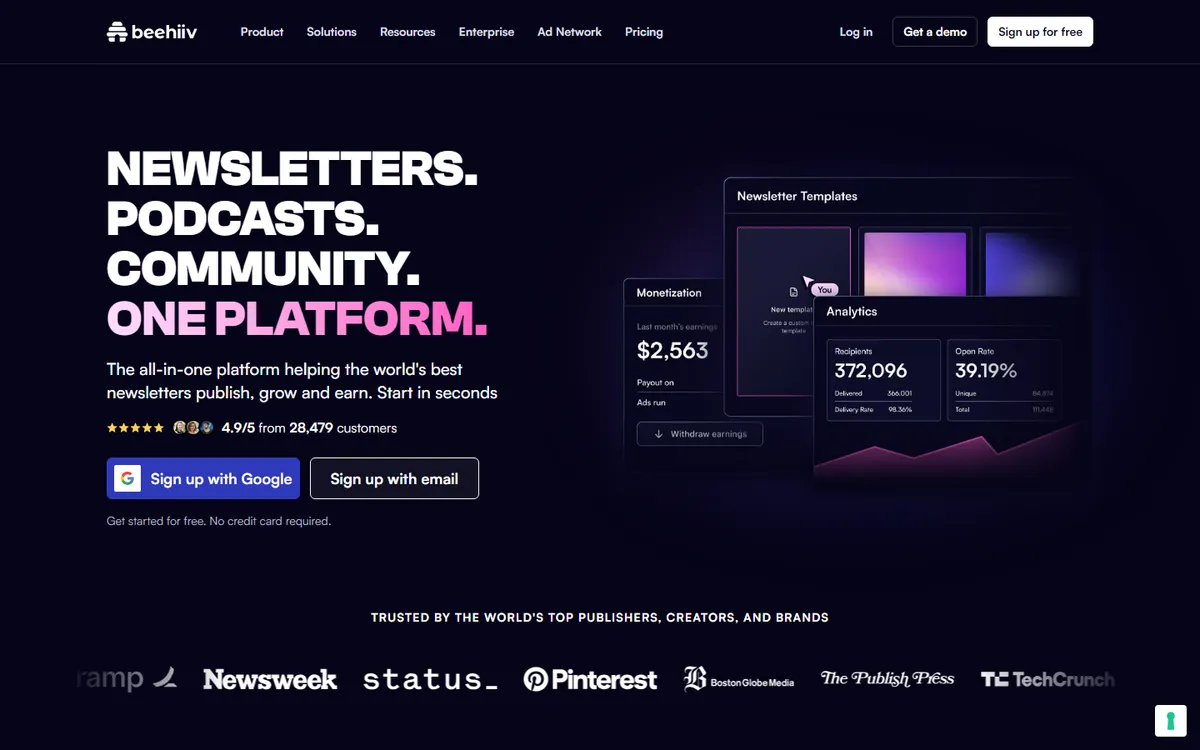
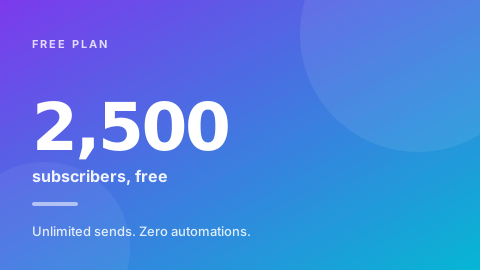
beehiiv was built specifically for newsletters rather than adapted from general email marketing, and the free tier shows it: 2,500 subscribers, unlimited sends, and a custom domain at $0. That combination doesn't exist elsewhere — MailerLite's free plan stops at 250 subscribers, and most competitors put custom domains behind a paid tier.
It also includes the recommendation network on the free plan, which is genuinely how a lot of newsletters get their first thousand readers. And as of 2026 beehiiv ships an MCP integration for Claude and ChatGPT, with read access even on the free tier — a real differentiator if you work with AI assistants.
The catch is what the free plan leaves out, and it's significant: no automations at all. No welcome sequence, no drip. For a newsletter that's survivable. For anyone selling something, it isn't — and fixing it means $43/month.
- Free to 2,500 subscribers with unlimited email sends
- Custom domain included at no cost
- Recommendation network on free plan — real growth channel
- 0% take rate on paid subscriptions from the Scale plan
- MCP support for AI assistants, read access even when free
- No automations whatsoever on the free plan
- Removing beehiiv branding requires the Max plan — $96/month
- $43/month Scale is a steep first paid step vs MailerLite's $10.80
- Price rises with each subscriber tier — model your cost at 10K, not today
- Newsletter-shaped: a poor fit if you need general marketing email
Our link applies 20% off your first 3 months if you upgrade.

MailerLite
Best value for automation on a budget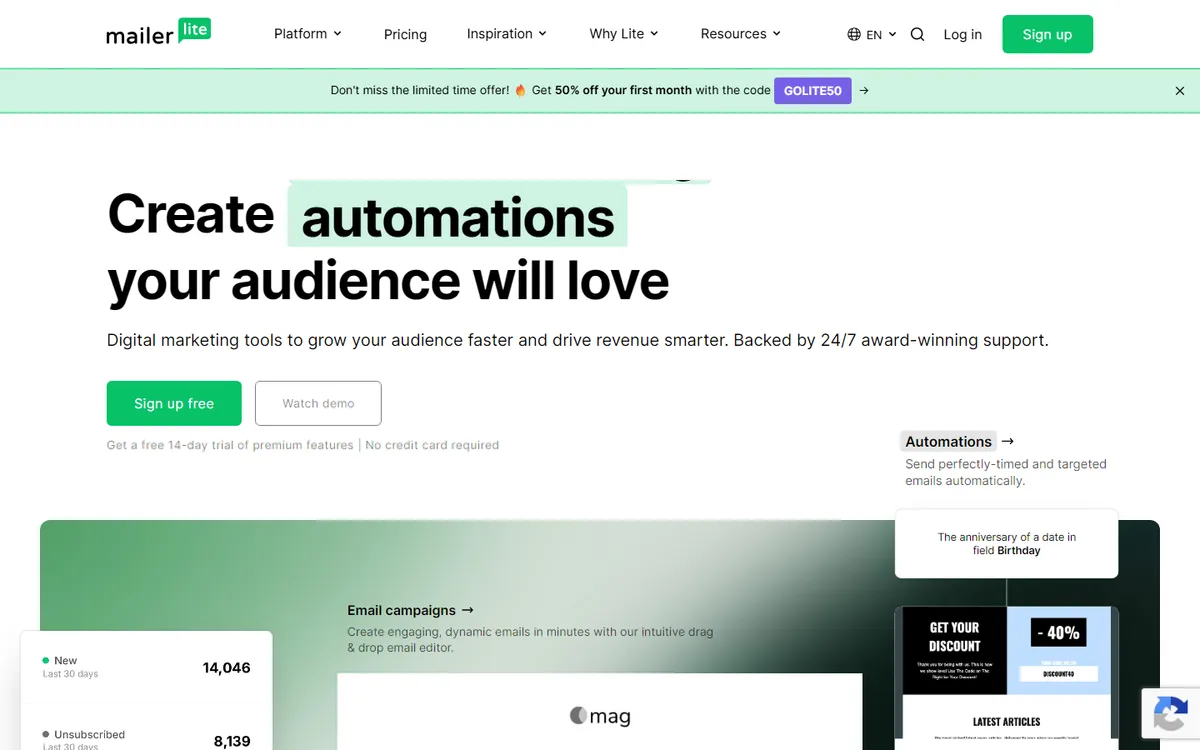
At $10.80/month billed annually, MailerLite's Comfort plan is the cheapest serious email tool in this comparison, and unlike beehiiv it gives you automations from the free plan up. Fifty active automations on Comfort, with 100 steps each, is more than most creators will ever use.
It's also the most complete package for the money: landing pages, websites, signup forms, digital product sales and bookings all included rather than sold separately. And MailerLite ships an MCP integration too, on every plan including free.
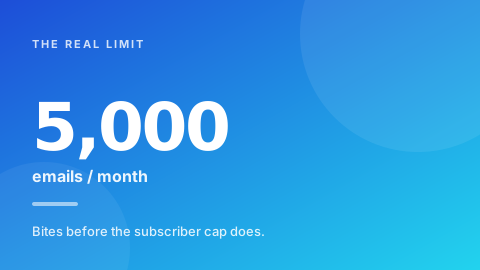
But there's a trap in the pricing, and it's the one to understand before you commit. MailerLite advertises by subscriber count, but the Comfort plan also caps you at 5,000 emails per month. With 500 subscribers, a weekly newsletter uses about 2,000 — fine. Go twice a week, or grow to 1,200 subscribers, and you hit the sending ceiling long before the subscriber ceiling. The fix is the Power plan at $22.50, roughly double. Compare on emails per month, not subscribers.
- Cheapest credible paid plan here — $10.80/mo annually
- Automations included even on the free plan
- Landing pages, websites and forms bundled, not upsold
- 24/7 support on paid plans; live chat on Power
- MCP support for Claude and ChatGPT on all plans
- 14-day full-feature trial with no credit card
- 5,000 emails/month cap on Comfort — bites before the subscriber limit does
- Free plan is small: 250 subscribers, 2,500 emails/month
- Free plan support is community-only
- Removing MailerLite branding requires a paid plan
- Known for a strict manual approval process for new accounts

Ghost
Best if you want to own the platform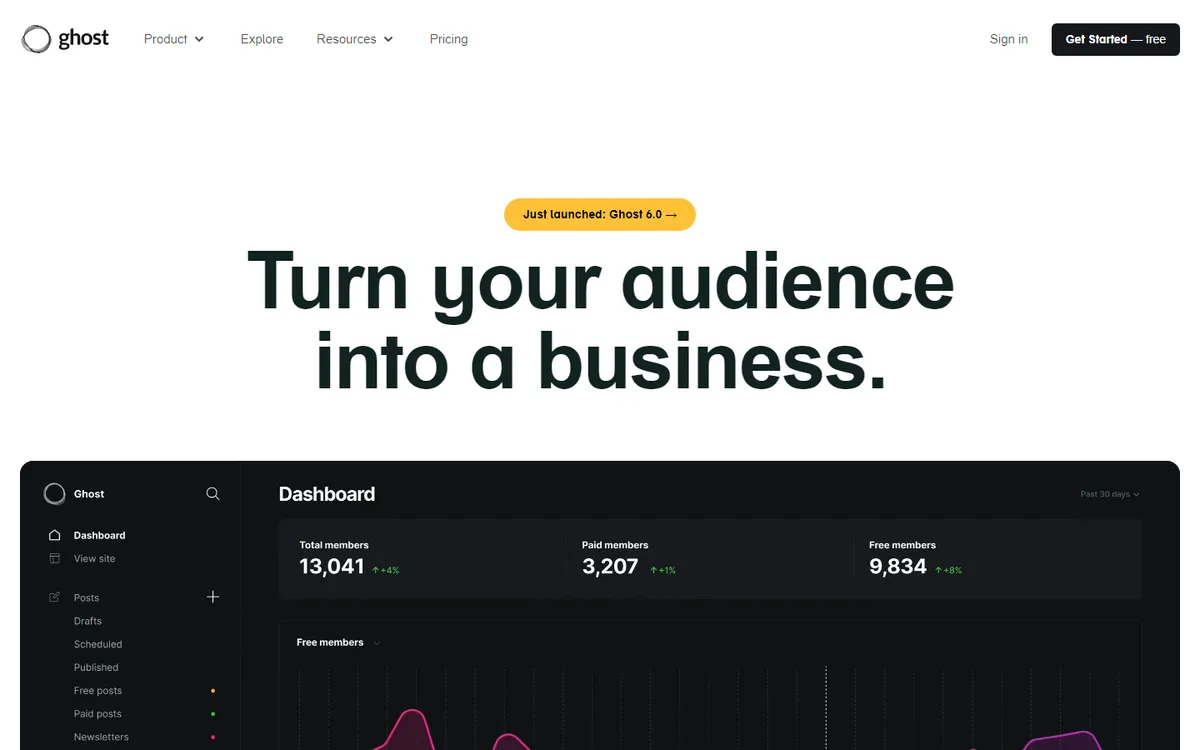
Ghost is the choice for creators who've thought about what happens if the platform changes its mind. It's open source, so you can self-host at pure infrastructure cost and nobody can deplatform you or take a cut. Ghost(Pro) is the managed version, from $15/month.
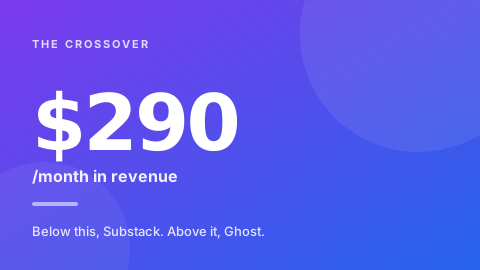
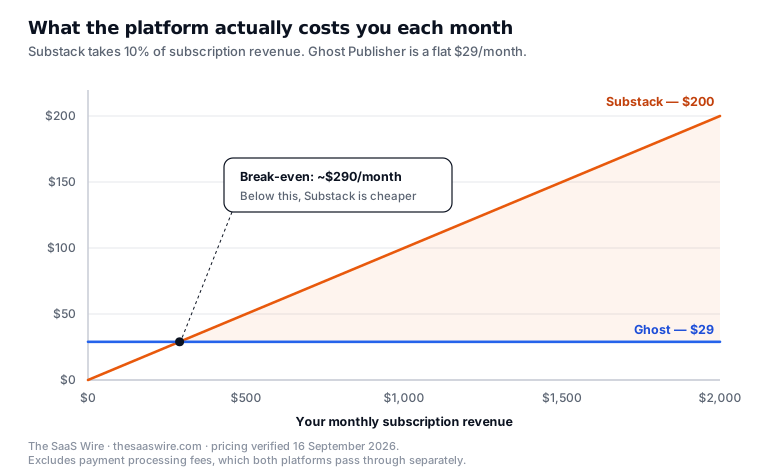
The number that matters: 0% transaction fees on paid subscriptions. Against Substack's 10%, the maths is brutal. At $1,000/month in subscriptions, Substack takes $100 and Ghost Publisher costs $29 — a $71/month difference, $852 a year, growing as you do. The break-even is around $290/month of revenue.
Two honest caveats. First, paid subscriptions require the Publisher plan at $29, not the $15 Starter — the cheap plan can't take money. Second, the jump from Publisher ($29) to Business ($199) is savage, with nothing in between; when you outgrow 1,000 members you face a near-7x increase. And Ghost's automation is thin — it expects you to wire up Zapier or n8n.
- 0% transaction fees on paid subscriptions
- Open source — self-host free, no lock-in, no deplatforming
- Unlimited email sends on every plan
- Free custom domain even on Starter
- Genuinely good publishing experience and SEO tooling
- 3 premium tiers and 15 special offers on Publisher
- Paid subscriptions need Publisher ($29), not the $15 Starter
- No free plan on Ghost(Pro) — self-hosting needs technical skill
- $29 → $199 price cliff with nothing in between
- Weak native automation; expects Zapier or n8n
- Starter is restrictive: 1 user, no custom themes, no paid subs

ActiveCampaign
Best for serious automation — at the real price
ActiveCampaign is the most powerful automation platform here, and if your business genuinely runs on conditional logic, lead scoring and CRM-linked sequences, nothing else in this comparison is close.
But the advertised $15 Starter plan is a trap, and this is the single most useful thing on this page. Starter limits you to 5 actions per automation. A basic welcome sequence — wait, send, check if opened, branch, send — is five actions. You've hit the ceiling on your first workflow. People choose ActiveCampaign for its automation, and the entry plan removes precisely that.
The realistic entry point is Plus at $49/month, which is where automation actions become unlimited. That's over three times the headline price. Budget accordingly, and treat any roundup quoting "$15/month" without this caveat as one that never opened the product.
One more thing worth knowing: ActiveCampaign prices by region. Visiting from Brazil we were shown R$70/R$217/R$364/R$658 with no notice; the dollar figures only appeared when we forced the currency. Check what your own country is being quoted.
- The most capable automation engine in this comparison
- Unlimited automation actions from the Plus plan up
- Built-in CRM and ecommerce integrations
- 950+ prebuilt automation recipes
- 30-day money-back guarantee
- Predictive sending and conditional content on Pro
- Starter caps automations at 5 actions — effectively unusable for its main purpose
- Real entry price is $49/mo, over 3x the advertised $15
- No free plan at all
- Plus still gives only 1 user seat; 3 seats needs Pro at $79
- Overkill and overpriced for a plain newsletter
- Prices vary by country without clear warning

Substack
Best for starting today — and it pays us nothing
Substack has no affiliate program. We earn precisely zero from this recommendation, and it is here because leaving it out would make this article dishonest. If you ever read a "best newsletter platform" roundup that omits Substack entirely, you have learned something about how that article was assembled.
Substack's case is simplicity. There is no plan to choose, no sending limit to model, no setup. You write and press send, and there is a built-in discovery network that genuinely sends readers to new writers — worth more than most paid growth features.
The cost arrives later, as 10% of paid subscription revenue, forever, on top of Stripe's fees. That's free while you earn nothing and expensive when you succeed: at $2,000/month you're paying Substack $200/month for infrastructure Ghost would give you for $29. You also give up design control and own less of the relationship.
Our honest read: Substack is the right first platform for most writers and the wrong permanent one. Start here if the alternative is not starting. Move when your paid revenue passes roughly $300/month — Substack does let you export your list, so the exit is real.
- Genuinely free until you charge readers
- Zero setup — publishing within minutes
- Real discovery network that sends you readers
- No subscriber or sending limits
- Subscriber list is exportable — you can leave
- 10% of paid revenue, permanently — punishes success
- No automations at all
- Little design control; every Substack looks like Substack
- You're building on their audience relationship, not yours
- Platform's editorial controversies attach to your brand
A note on Kit (formerly ConvertKit)
Kit is the platform most associated with creator email, and you'd reasonably expect it in this comparison. It isn't ranked above for a specific reason we'd rather state than hide: we could not verify Kit's current pricing. Its pricing page returned an anti-bot challenge on both our attempts on 16 September 2026, and we don't work around those — nor would we quote a price we hadn't actually read.
So rather than publish a figure from memory or copy one from another blog — the two most common sources of the stale pricing that makes these articles useless — we've left Kit out of the table. We'll add it, ranked on the same basis as everything else, as soon as we've read the prices ourselves. Kit remains a strong option, particularly for creators selling digital products, and this absence is a limitation of our verification, not a judgement on the product.
Questions we get asked
What's the best free email platform for creators?
beehiiv, on volume: 2,500 subscribers, unlimited sends and a custom domain at $0. But it has no automations, so if you need a welcome sequence, MailerLite's free plan is better despite stopping at 250 subscribers — it includes three automations. Substack is unlimited and free but takes 10% once you charge.
Is ActiveCampaign's $15 plan enough?
Not for automation, which is the reason to choose ActiveCampaign. Starter caps you at 5 actions per automation — one simple welcome sequence. The real entry point is Plus at $49/month. If $49 is beyond budget, MailerLite at $10.80 will serve you better than a crippled ActiveCampaign.
Ghost or Substack for a paid newsletter?
Maths, not preference. Substack takes 10% of revenue with no fixed cost; Ghost Publisher costs $29/month and takes 0%. Below roughly $290/month in subscription revenue Substack is cheaper. Above it, Ghost wins by a widening margin — at $2,000/month you'd pay Substack $200 versus Ghost's $29.
Start on Substack if you're not yet earning. Move to Ghost when you are.
How much does it cost to switch platforms later?
All five let you export subscribers as CSV, so your list isn't hostage. What doesn't transfer is everything built around it: automations, landing pages, signup forms, your archive's URLs and their search rankings. Budget a weekend, and expect a deliverability dip for a few sends while the new platform builds reputation with your list.
This is why the free plan matters less than it seems. The expensive decision isn't what you pay in month one, it's the one you'll regret in year two.
Do you earn commission from these recommendations?
From some of them, yes. beehiiv, MailerLite and ActiveCampaign run partner programs. Ghost and Substack do not — Ghost is a non-profit and neither pays commissions to review sites. We rank them 3rd and 5th anyway, because they're the right answer for the readers we say they're right for.
We write the ranking before adding any affiliate link, specifically so commission rates can't quietly become a ranking factor. Our disclosure page sets out the rules, and the right response is to check them against what we actually publish.
The verdict
There is no single winner here, and any article claiming one is selling you something. What we'd actually tell a friend:
- Writing a free newsletter and want room to grow? beehiiv. Nothing else gives you 2,500 subscribers, unlimited sends and a custom domain for nothing.
- Need automation without spending much? MailerLite at $10.80/month — just size it on emails per month, not subscribers.
- Charging readers, or planning to? Ghost. The 0% cut pays for itself past ~$290/month of revenue and keeps paying.
- Business genuinely built on automation? ActiveCampaign Plus at $49. Not the $15 plan.
- Haven't started yet? Substack, today, for free. Starting beats optimising, and you can leave later.
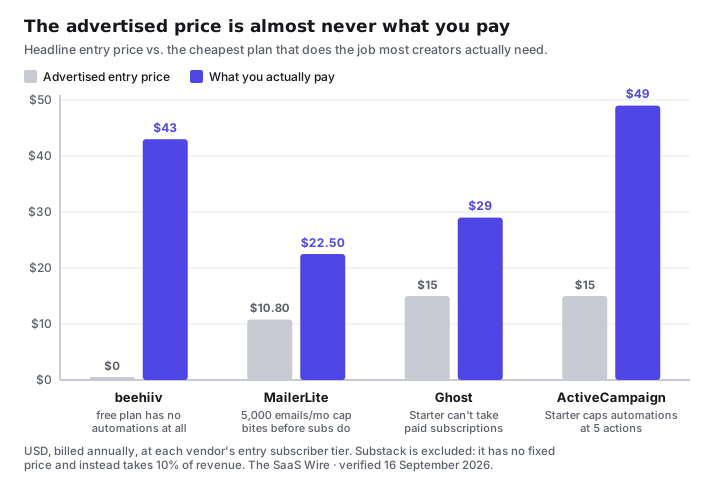
The mistake we'd most like to save you from isn't choosing the wrong platform — it's choosing on the advertised entry price. In this category the headline number is almost never what you end up paying. Model the cost at the size you expect to be in a year, and check what the plan you'll actually need costs.
Pricing in this article was read directly from each vendor's pricing page on 16 September 2026, in USD with annual billing unless stated. SaaS pricing changes frequently — if you find a figure that's out of date, tell us and we'll correct it and re-date the page. Kit's pricing could not be verified on this date; see the note above.